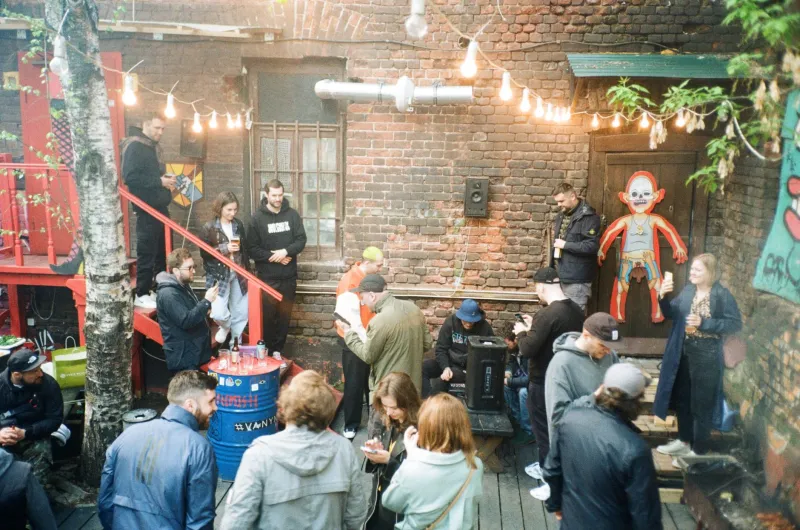
We Welcome Everyone (Except You): The Quiet Hypocrisy Rotting Underground Scenes From the Inside

There's a sign — metaphorical, usually, sometimes literal — hanging over the entrance to every underground scene in America. It says something like All Are Welcome Here. It's on the flyers, in the Discord bios, stitched into the community guidelines of a hundred different subreddits and Telegram channels. And most of the people who put it there genuinely believe it.
That's what makes this so uncomfortable.
Because the same communities that plaster that message everywhere have developed some of the most sophisticated social filtering systems this side of a country club membership committee. They just don't call it filtering. They call it taste. They call it authenticity. They call it protecting the culture.
Let's talk about what it actually is.
The Velvet Rope Made of Vinyl
Spend any time in underground music circles — hardcore, experimental electronic, DIY punk, noise, whatever your flavor — and you'll clock the moment it happens. Someone new shows up. Maybe they found the scene through an algorithm, or a friend of a friend, or a YouTube rabbit hole. They're enthusiastic. They're a little too enthusiastic. They clap at the wrong moment. They ask who recorded the opening act. They're wearing a shirt for a band that the regulars have collectively decided represents something lesser.
The rejection isn't loud. It rarely is. It's a turned shoulder. A conversation that doesn't quite include them. An inside reference deployed just fast enough that they can't catch it. A raised eyebrow exchanged between two people who've been coming to this basement for three years.
This is gatekeeping in its most natural habitat: deniable, ambient, and devastatingly effective.
The person leaves. The regulars didn't do anything, technically. And the scene stays exactly as it was — which is, of course, the whole point.
When Curation Becomes a Cover Story
Here's where the rationalization gets interesting. Ask any committed scene participant whether they're being exclusionary, and they'll usually have a ready answer. They're not keeping people out — they're maintaining standards. They're not elitist — they're protecting a space that took years to build. They're not gatekeeping — they're curating.
And honestly? Some of that is legitimate. Scenes do require tending. Communities that let absolutely anyone define the terms of engagement often collapse into chaos or get co-opted by people with no investment in the thing they've wandered into. There's a real conversation to be had about what it means to preserve something fragile.
But there's a difference between protecting a community and policing who gets to feel comfortable in it. And a lot of underground scenes have quietly slid from the first thing into the second without ever stopping to notice the transition.
The tell is usually in the language. When the conversation shifts from what do we value to who deserves to be here, you've crossed a line. And in a lot of scenes, that line got crossed so long ago nobody even remembers where it was.
The Unwritten Syllabus
Every underground scene has one: a body of knowledge you're expected to have absorbed before you show up. Not written down anywhere. Not explained to newcomers. Just... understood, by the people who are already in.
In certain punk circles, it's a familiarity with specific regional lineages — knowing which bands influenced which, which splits matter, which labels had integrity and which sold out. In experimental music scenes, it might be a fluency with academic theory, or a demonstrated contempt for anything that sounds too accessible. In some hip-hop underground spaces, it's about being able to place a sample, to situate a producer within a web of influences that stretches back decades.
None of this knowledge is inherently bad to have. The problem is when it becomes a toll booth instead of a shared language. When the point stops being here's something cool we can explore together and starts being let me see if you already know this before I decide you're worth talking to.
The unwritten syllabus isn't about passion. It's about proof of prior membership. And it functionally excludes anyone who didn't grow up with access to the right record stores, the right older siblings, the right zip codes.
Call It Out and Watch What Happens
The real stress test for any underground scene's stated values comes when someone names what's actually happening. And it does happen — usually online, occasionally in person, almost always messily.
Someone posts about feeling unwelcome. Or they write up a thread about how a supposedly inclusive space spent an entire evening making them feel like an anthropology exhibit. The responses are instructive. There's usually a wave of defensive energy, a chorus of that's not what we're about, a few people who've clearly been waiting to say the same thing piling on in solidarity, and then — if the original poster is lucky — a grudging, qualified acknowledgment that maybe something to think about has been raised here.
What almost never happens is a genuine reckoning. Because that would require the people who've built their identity around this scene to admit that the identity they've built has a shadow side. That the exclusivity they've been practicing — and yes, often enjoying — is in direct contradiction to the values they claim out loud.
That's a hard thing to sit with. So most scenes don't sit with it. They wait for the noise to die down and go back to doing what they were doing.
Who Actually Gets to Be Underground?
There's a bigger question lurking underneath all of this, and it's one that underground culture in America has been avoiding for a long time.
When we talk about who belongs in these spaces, we're almost always also talking about race, class, gender, and geography — whether we admit it or not. The unwritten syllabi are often coded. The taste-policing frequently lands harder on people of color, on women, on working-class folks who didn't have the leisure time to accumulate the right cultural capital. The scenes that pride themselves most loudly on being outside the mainstream are sometimes the whitest, most economically homogeneous rooms in the building.
This isn't a comfortable thing to say about spaces that often see themselves as progressive, even radical. But the discomfort is the point. Underground culture didn't originate with the people who are currently most comfortable in it. And the continued exclusion of the people closest to those origins — in favor of those who've made a lifestyle aesthetic out of rebellion — is its own kind of theft.
The Scene You Actually Want to Be
None of this means underground scenes are uniquely bad, or that curation is inherently wrong, or that anyone who's ever given a skeptical look to a newcomer is irredeemable. Humans build in-groups. Communities develop codes. That's just what social organisms do.
But the specific claim that underground culture keeps making — that it stands for something different, that it's a refuge from the hierarchies of the mainstream, that it's genuinely more welcoming than the world outside its walls — that claim has to be earned. Repeatedly. Not just written on a flyer.
The scenes worth being part of are the ones that can actually hold that tension: maintaining enough coherence to survive while staying honest about the ways their doors are harder to open for some people than others. That's harder than posting a welcome message. It requires people who've been in the room a long time to occasionally sit down and let someone else speak first.
It requires, in other words, giving up some of the power that comes with being a gatekeeper.
Most scenes aren't there yet. A few are trying. And the ones that are trying tend to be a lot more interesting to be around than the ones still pretending the door was always open.