Gone in 72 Hours: The Death Clock Ticking Over Every Underground Scene

Photo by Photo by Alex G on Unsplash on Unsplash
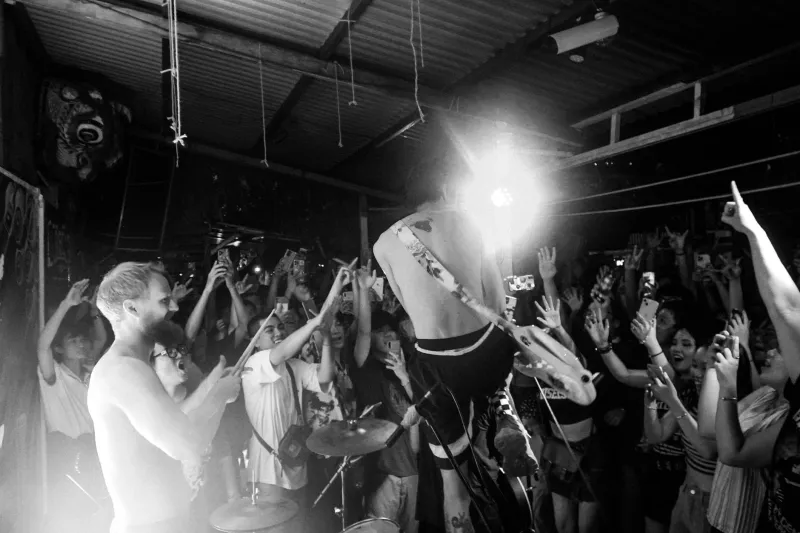
There's a specific kind of grief that comes with watching something you love get strip-mined for content. Ask anyone who was deep in a local scene — hyperpop, midwest emo, neo-soul, footwork, whatever — before the algorithm found it. One week you're in a sweaty basement with thirty people who get it. Three weeks later, a sound is trending on TikTok with 40 million views, a major label has signed the most photogenic artist in the room, and the rest of the community is left holding the cultural equivalent of an empty bag.
This isn't a new story. Punk got co-opted. Grunge got co-opted. Hip-hop got co-opted. But the speed at which it's happening now? That's something different entirely. That's a new beast.
The Compression Problem
Cultural cycles used to move in years. Punk had roughly a decade of genuine underground momentum before it became a Hot Topic aesthetic. Early hip-hop built entire neighborhood ecosystems over the course of a generation before crossover happened. Even in the internet era, scenes like vaporwave and chillwave had a few solid years of relative obscurity to develop identity, vocabulary, and community before the think-pieces arrived.
Now? We're talking weeks. Sometimes days.
DJ and producer Marcelline Torres, who's been working the Chicago underground dance circuit for over a decade, describes watching a micro-genre she helped build get consumed in real time. "I've seen it happen twice now," she says. "You spend two years building something with your people. Then somebody posts a clip, it goes viral, and by the time the weekend is over, there are brands in the comments asking about licensing. It's like watching your house get renovated by people who don't live there."
The mechanism is ruthlessly efficient. A sound or aesthetic gets captured in a short video. The algorithm, optimized for novelty and engagement, amplifies it to a massive audience. Trend forecasters and content farms pile on. Mainstream media writes the explainer piece. A brand does a collab. And then — silence. On to the next one.
For the underground, the fallout is brutal. What took years to build gets consumed in a content cycle that lasts about as long as a news story about a celebrity feud.
Scenes as Raw Material
Cultural analyst and writer Devon Okafor, who covers alternative communities for several independent outlets, argues that the core problem is structural. "Social media platforms aren't built to sustain subcultures," he says. "They're built to extract value from them. A scene that took three years to develop has maybe three months of algorithmic novelty before it gets processed and moved past. The platform doesn't care what happens to the community afterward."
This extraction model treats underground culture as raw material — something to be mined, refined, and sold back to a mass audience in a more palatable form. The original community often gets left behind, sometimes literally priced out as their neighborhoods and venues get "discovered" and gentrified in the wake of attention.
What's particularly brutal is that the artists themselves often have no control over the process. A single video clip, posted without context, can blow up a carefully cultivated aesthetic in ways the creator never intended. The nuance gets stripped out. The community that gave the art meaning disappears from the narrative. What's left is a vibe, a sound, a look — divorced from the actual human beings who built it.
Faster Evolution or Faster Death?
Not everyone is ready to call it a funeral, though. Some scene veterans argue that the compression is forcing underground culture to mutate faster, to stay perpetually ahead of the mainstream's reach.
Tamara Reyes, who runs a DIY collective in Los Angeles that's cycled through several aesthetic identities in the past four years, sees it as an arms race with its own weird energy. "The scenes that survive are the ones that can't be easily packaged," she says. "We've started deliberately making things more specific, more localized, more weird. The algorithm wants things that are digestible. So we make things that aren't."
This strategy — radical specificity as a defense mechanism — is showing up in underground communities across the country. Hyper-local references. Deliberately inaccessible entry points. Events that are hard to find, harder to document, and deliberately resistant to the kind of clean aesthetic that photographs well for social media.
It's a form of cultural camouflage. And it's working, at least temporarily.
The Veterans Who've Seen It Before
Talk to anyone who's been around long enough, and they'll tell you the grief is real but the scene never fully dies. It goes underground. It mutates. It finds new rooms and new vocabularies.
Rick Avalos has been playing in underground punk and noise bands in the Southwest for over twenty years. He's watched multiple scenes he loved get devoured by the content machine and emerge, changed but alive, on the other side. "Every time something gets taken, something weirder and harder to steal takes its place," he says. "I've stopped mourning the versions that get absorbed. I just get excited about what comes next."
That resilience is real. But it comes with a cost — the constant labor of rebuilding, the emotional toll of repeated loss, the artists who burn out before the next iteration arrives.
What's Actually Being Lost
Here's the thing that doesn't make it into the trend pieces: it's not just sounds and aesthetics that get lost when a scene burns out in 72 hours. It's the relationships. The mentorships. The institutional knowledge of how to run a show, start a label, book a tour. The sense of belonging that kept people making art when the world gave them no reason to.
That stuff doesn't go viral. It doesn't compress into a 15-second clip. And when a scene gets consumed before it has time to build those roots, a generation of artists loses access to the scaffolding that would have sustained them.
The TikTok graveyard is real. But the people who built those scenes are still out there, still making things, still finding each other in the dark. The question is whether we're going to keep letting the algorithm set the timeline — or whether underground culture is finally ready to start playing by its own clock again.