They Built the Fire and Now They Can't Stop Watching It Burn Everything Else Down
There's a specific kind of grief that doesn't have a name yet. It's the feeling you get when you watch something you built with your bare hands — something raw and weird and genuinely yours — get swallowed whole by the exact machine you designed it to escape. It's not quite loss, because the thing still exists. It's not quite pride, because what it's become barely resembles what you made. It sits somewhere in the middle, heavy and unresolved, and it haunts a lot of the people who built America's most vital underground scenes.
They don't talk about it much. That's part of the code. You don't complain about success in a culture that spent years fighting for survival. But spend enough time in basements, DIY venues, and the back booths of scene bars across this country, and you start to hear it — the quiet, complicated reckoning of founders who got exactly what they worked for and can't figure out why it feels like a betrayal.
The Dream That Eats Itself
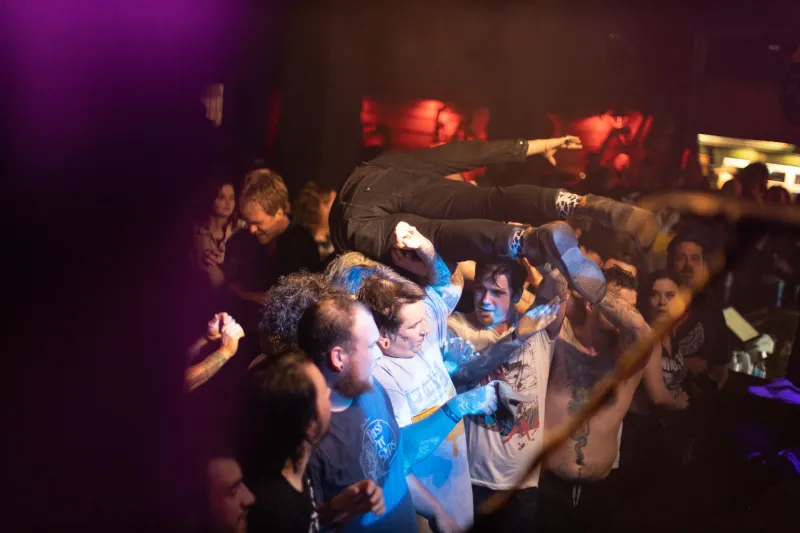
Most underground scenes don't start with a manifesto. They start with a problem. A city with nowhere to play. A community with no venue that felt safe. A genre with no radio station willing to touch it. The founders — and calling them that already feels too corporate, too Silicon Valley, but let's use it anyway — were usually just people solving a problem for themselves and their friends.
The Chicago footwork scene didn't emerge because someone sat down and decided to build a cultural institution. The early hardcore shows in DC basements weren't organized by people with five-year plans. The queer club nights that birthed entire movements in New York and LA started because someone needed a room where they could exist without apology. The underground, almost always, begins as an act of necessity.
Which is exactly why it's so disorienting when it becomes an act of commerce.
The moment a scene tips — when the Vice documentary drops, when the think-piece cycle begins, when the festival booker starts calling — something shifts for the people who were there at the beginning. Not just the scene itself, but their relationship to it. Suddenly the thing they built as a refuge is a destination. The people they made space for are now a demographic. The aesthetic they developed out of poverty and stubbornness is a mood board for a brand campaign.
Guilt Without a Crime
Here's the part nobody wants to say: a lot of founders feel responsible. Not in a legal sense, obviously. But in a deeper, gnawing way that doesn't respond to logic.
They're the ones who said yes to the first interview. They're the ones who let the photographer in. They're the ones who agreed to play the bigger festival because they needed the money, because the DIY space needed a new PA system, because the community needed health insurance and exposure and all the things that underground scenes can't generate on their own forever.
Every one of those decisions made sense at the time. Every single one. And the sum of all those reasonable decisions is a scene that no longer belongs to the people who built it.
That math is brutal. And the guilt it produces is genuinely corrosive — not because the founders did something wrong, but because there was no clean path that avoided this outcome. You can't keep a scene alive indefinitely through sheer willpower and broke idealism. At some point, survival requires compromise. The tragedy is that compromise accumulates.
The Identity Trap
What makes this harder is that for a lot of scene founders, the scene is their identity. Not in a shallow way — in a foundational way. The music they made, the community they built, the values they fought for: these aren't hobbies. They're the architecture of a self.
So when the scene gets co-opted, it doesn't just feel like losing a place or a movement. It feels like losing a version of yourself. The person who made this thing — the one who stayed up until 4 AM booking shows for no money, who drove six hours to bring an artist to a city that had never heard of them, who turned a condemned warehouse into a home for people who had none — that person starts to feel like a stranger.
Psychologists have a term adjacent to this: identity foreclosure. It's what happens when the thing you've built your sense of self around gets taken away or transformed beyond recognition. The disorientation is real. The grief is real. And it's made worse by the fact that the culture around underground scenes doesn't really give you permission to grieve publicly without looking like you're gatekeeping, whining, or both.
The Responsibility Question
So do founders bear responsibility for stopping commercialization? The honest answer is: kind of, sometimes, but not in the way the purity police want to frame it.
There are real choices involved. Saying no to certain partnerships. Building governance structures that distribute power away from any single founder. Creating explicit community agreements about what the scene will and won't accept. Some founders have done this brilliantly. Others watched the tide come in and didn't think it would reach this far.
But let's be clear about something: the burden of protecting underground culture from commodification should not fall entirely on the people who built it from nothing. The real culprits — the brands, the festivals, the media companies, the real estate developers — have resources and infrastructure and entire PR teams dedicated to making co-optation look like celebration. Expecting a broke scene founder to out-maneuver that alone is a fantasy.
What founders can do, and what the best of them are doing, is talk about it honestly. Name what happened. Document the before. Refuse to let the sanitized version become the official history. That's not gatekeeping. That's witness.
What Comes After the Reckoning
Some founders walk away. They start something new, smaller, more hidden, and they're more careful this time about who gets the keys. Some stay and fight from the inside, trying to steer the thing they built even as it grows past their ability to control it. Some burn out entirely and spend years trying to figure out who they are when the scene is no longer the answer.
All of those responses are valid. None of them are easy.
What's worth holding onto is this: the impulse that built the scene in the first place — the refusal to accept the world as it was handed to you, the insistence on making space where there was none — that doesn't disappear when the scene gets swallowed. It just needs somewhere new to land.
The underground has always been defined by its ability to regenerate. Scenes die, scenes get bought, scenes become the thing they hated. And then somebody, somewhere, starts solving a problem for themselves and their friends, and it begins again.
The founders who are haunted by their success aren't failures. They're evidence that something real happened. And that might be the most underground thing of all.