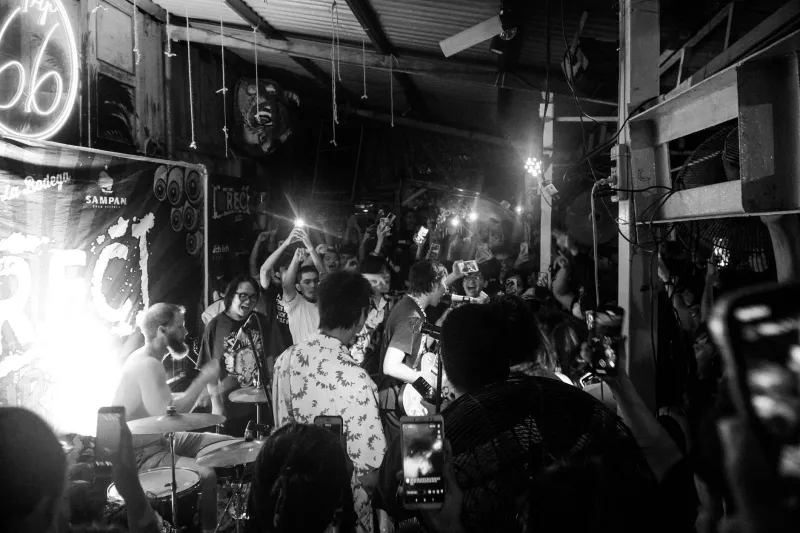
Stuck in Amber: How Underground Scenes Are Turning Their Best Years Into a Cage
Photo: Stephen Kelly from San Francisco, CA, USA, CC BY 2.0, via Wikimedia Commons
There's a version of this story playing out in basements, Discord servers, record store back rooms, and zine distros all across the country right now. Somebody who was there — really there, during the years that mattered — is explaining, with total authority, why what's happening today doesn't count. Why the new kids don't get it. Why the scene peaked somewhere between 2007 and 2011, or 1994 and 1997, or whatever window of time they happened to walk through first.
And they're not entirely wrong. That's the brutal part.
Those years probably were extraordinary. The energy was real. The stakes felt higher because nobody knew if any of it would survive. The community was tighter because it had to be. When you build something in the dark, with no money and no attention, you form bonds that genuinely don't replicate under better conditions.
But here's what's getting lost in all that reverence: the scene they're protecting like a museum exhibit was itself an act of rebellion against whoever came before them.
The Fossil Becomes the Wall
Underground culture has always survived by eating itself and growing back stranger. Punk devoured itself and produced post-punk, no wave, hardcore, and eventually a hundred subgenres that would have horrified the original CBGB faithful. Hip-hop's underground kept mutating because the kids coming up didn't feel obligated to replicate what came before — they felt obligated to wreck it and rebuild it in their own image.
That's not disrespect. That's the whole mechanism.
When a scene stops allowing that mutation — when the veterans start treating the founding mythology as sacred text rather than raw material — the scene stops being a living thing. It becomes a tribute act to itself. And tribute acts, however technically proficient, never actually scare anybody.
The tragedy isn't that old-timers love what they built. The tragedy is that their love has curdled into something that looks a lot like control. The golden era stops being a source of inspiration and starts functioning as a barrier to entry — a credentialing system where the only valid credential is having been there before most of the current membership was old enough to drive.
What Gets Called Authenticity Is Usually Just Seniority
Spend any time in legacy underground spaces and you'll notice the word "authentic" doing a lot of heavy lifting. New artists aren't authentic. New fans don't understand what the scene is really about. New venues don't have the right vibe. New production techniques are a sellout move. New approaches to community-building are suspicious at best.
Strip away the aesthetic language and what you're usually left with is something simpler: you're not from here, and here is mine.
Authenticity in underground culture was never supposed to mean "identical to what existed before." It meant something closer to genuine — made with real intent, without commercial compromise, connected to actual human experience rather than market research. By that original definition, a 19-year-old making hyperpop in her bedroom at 2 a.m. because she can't sleep and needs to process something is about as authentic as it gets. The fact that she's never heard of whatever seminal 2003 record the gatekeepers consider required reading doesn't change that.
But in scenes that have calcified around nostalgia, authenticity has been quietly redefined as familiarity. Knowing the right records. Using the right vocabulary. Performing the right kind of reverence for the right historical moments. It's become a cultural SAT — a test of memorization disguised as a test of character.
The Rebel Who Forgot How to Rebel
Here's the sharpest irony baked into all of this: the people most aggressively policing scene boundaries in the name of authenticity are often the same people who built their entire identity around rejecting exactly that kind of policing.
The punk who got told his music wasn't real music. The hip-hop head who got dismissed by the mainstream. The queer artist who got shut out of every legitimate space and had to build her own. They remember what it felt like to be on the outside of something, told their contribution didn't count, their approach was wrong, their presence was unwelcome.
And then, somewhere along the line, they became the institution.
It doesn't happen because people are cynical or deliberately hypocritical. It happens because scenes create identity, and identity hardens. The things that made you feel seen and understood become the things you need to protect. Protecting them starts to feel like protecting yourself. And before long, you're doing to the next wave exactly what was done to you — not out of malice, but out of fear that if the scene changes too much, the version of yourself that the scene validated will disappear with it.
Making Room Without Burning the Archive
None of this means scenes should abandon their histories. The archives matter. The oral traditions matter. Knowing where something came from is part of understanding what it can become.
But there's a difference between passing something down and using it as a weapon. There's a difference between saying "here's what we built and why it mattered" and saying "here's what we built and nothing you build will ever matter as much."
The scenes that stay vital — the ones that keep producing genuinely new things decade after decade — are the ones that figured out how to hold both at once. Respect the foundation. Let somebody else design the next floor.
That means veterans actively making space, not just tolerating newcomers but genuinely investing in them. It means resisting the urge to treat every departure from established aesthetic as a betrayal. It means accepting that the next legendary moment in your scene's history probably won't look anything like the last one — and being excited about that rather than threatened by it.
The underground was never supposed to be a preservation society. It was supposed to be a raid — ongoing, unpredictable, impossible to fully contain. The minute it stops moving, it stops being underground. It just becomes another institution with better record collections.
And nobody ever changed the world by protecting what already existed.